Have you considered buying a new piece of equipment for your editing suite? If you haven’t made so much progress after the thought, we understand!
It takes a reasonably long research process to make up your mind about the best thing to buy with the hard-earned cash that will give you the best value for your buck.
But did you ever think about getting some new speakers? Well, if you did, then it means one thing: your goal is to step up your video editing game.
In other words, you want to be able to mix your sound accurately, and the end product should be as good as it can be to the ear—which is crucial to video editing as a whole.
But, with a ton of options on the market, the search process gets even more stringent to find the best speakers for video editing.
Not to worry, in this article, you’ll learn about the factors you should consider before buying the best speakers for video editing and a few options you can get immediately.
Contents
Who Should Get This
Video editing has a lot to do with the arrangement and manipulation of video shots.
No doubt, the whole process could be tedious, especially for a professional that has a goal of staying on top of his game.
Technology has come to ease the whole process of video editing. And one of those things technology has introduced is speakers.
The speakers come in handy when you want your mixing to be accurate—which in turn helps in translating the right message of your content to the audience.
You may not need these speakers if you aren’t into professional video editing.
Best Speakers for Video Editing: Our Picks
If you want to learn about the best video editing speakers, this section covers their traits as well as what niches they fill.
1. Mackie MR6
- Best For: Overall
- Key Features: Strong sound quality and quick performance. Durable construction. Affordable. Optimized performance.
- Speaker Type: Bluetooth, Bookshelf
- Dimensions: 15.7 x 11.7 x 15.2 inches
- Weight: 18.5 pounds
If you want a good video editing speaker, it’s hard to beat the Mackie MR6. This speaker not only comes in at a solid price, but the performance is smooth and the sound quality is top notch. That combination makes it a great choice for people with medium or large spaces.
You get access to various applications on top of good drivers, matched amps, and stellar performance. They are also incredibly well built. That gives them an element of sturdiness you don’t always find when dealing with video editing speakers.
While these speakers are undoubtedly versatile, it’s important to note that you have to match them to your available space. Don’t be afraid to tweak them to match your personal preferences.
2. JBL Professional Studio


- Best For: Audio Quality
- Key Features: Large soundstage and excellent bass output. One-inch tweeter dome. Five-inch woofer. Great equalizer.
- Audio Output Mode: Stereo
- Dimensions: 14 x 12.2 x 13.93 inches
- Weight: 10.12 pounds
The Profession Studio from JPL is a great tool to add into your editing suite due to the accurate sounds and powerful audio. The one-inch tweeter dome and five-inch woofer driven by 41 watts come together to ensure you get the best possible results time and time again.
To further your listening experience, the speaker also has flexible connectivity, well-balanced inputs, and adjustable control volumes. The bass is great, while the improved HF and LF transducers work to reduce any harmonic distortion.
These speakers have a crisp, clear sound, but they do have a slight hiss from time to time. If you handle that, it’s hard to find something better for any of your video editing needs.
3. Yamaha HS8


- Best For: Precision
- Key Features: 8-inch cone woofer. Low distortion sound. Room control and high trim response controls. Efficient. Easy to control.
- Speaker Type: Monitor
- Dimensions: 13.1 x 9.8 x 15.4 inches
- Weight: 23.59 pounds
The Yamaha HS8 is a well-rounded speaker that’s crisp, clear, functional, and easy to control. This minimalist design is attractive and modern, and the one-inch dome tweeter works wonderfully with the eight-inch cone woofer to create a solid mix of power and quality.
This device has a quality build, as well as a frequency response of 38KHz to 30KHz. The frequency is nearly totally flat, while the screws and mounting points let you place the speaker wherever is best for your set up.
When using this option it’s important to note that they can pick up interference from other nearby devices. As long as you can navigate through that, they are a great addition to your video editing suite.
4. JBL Professional Compact
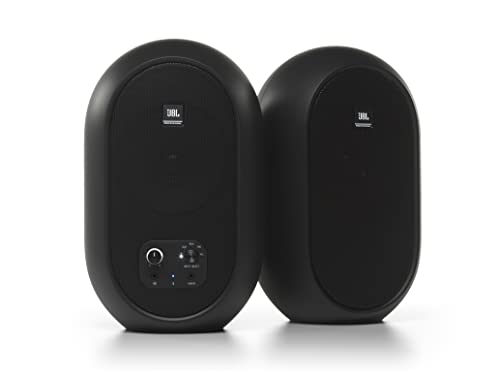

- Best For: Portability
- Key Features: Built-in Microphone. Portable. Small footprint. Amazing sound stage. Powerful and easy to set up.
- Connectivity Technology: USB
- Dimensions: 4.88 x 6.02 x 9.72 inches
- Weight: 15.9 ounces
If you want a smaller option that still delivers strong audio quality, the JBL Professional Compact is a great pick. This choice, which is both table top-mounted and comes with a 60-watt output wattage, has a 3.5mm headphone jack and can be used both at home or in a studio.
As the name suggests, they have a small footprint. That makes them especially useful for at-home editors who don’t have a ton of free space. As an added bonus, they also have a nice, chunky look that gives off a more professional vibe.
The biggest drawback with these speakers is the bass, which is a bit quiet. There’s also no Bluetooth or 1/4 inch cables, both of which hurt the functionality.
5. Pioneer DJ
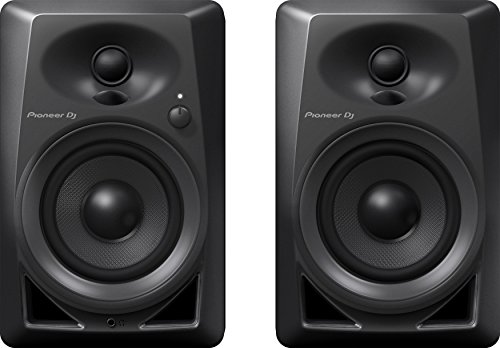

- Best For: Usability
- Key Features: 4-inch fiberglass woofers. Front-loaded bass. Lightweight and small. 3D stereo sound. Time alignment technology.
- Speaker Type: Desktop
- Dimensions: 15.6 x 10.6 x 13.6 inches
- Weight: 12.4 pounds
If you’re a video editor who doesn’t want to spend too much time messing with their speakers, the Pioneer DJ is a good option. These are extremely easy to both use and operate, and their streamlined design doesn’t come at the cost of any useful features.
These have a front-loaded bass reflex system through 4-inch fiberglass woofers, complete 3D stereo sound, as well as class AB amplifiers. The front edges are also curved to improve rigidity and cut down on resonance.
Just be aware that they aren’t great for larger spaces. They do a good job in a tighter area, but they lack the projection needed to fill a bigger room. Going lower than that, however, will create amazing results.
6. Mackie CR-X
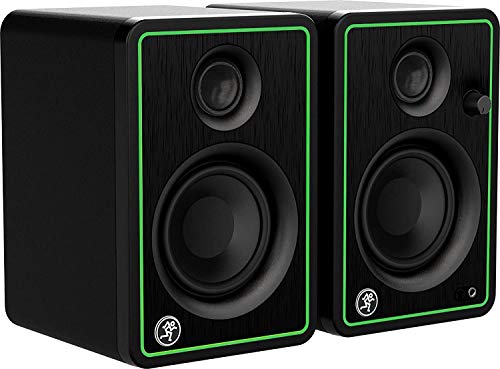

- Best For: Affordability
- Key Features: Compact. 80 Hz to kHz frequency. AUX and Bluetooth supported. Lightweight. Easy to manage. Included hookup cables.
- Speaker Type: Computer
- Dimensions: 5.5 x 8.1 x 7.1 inches
- Weight: 7.8 pounds
Video editing is not the cheapest hobby or profession, which is why it’s good to save some money where you can. The Mackie CR-X is an affordable speaker when compared to other top models, and it still comes with excellent sound quality and a well-rounded design.
It supports both AUX and Bluetooth. In addition, it’s lightweight, comes with 80 Hz to 20 kHz frequency, and has a slimmed down design. The easy operation is another top tier characteristic that makes these speakers a dream to use and control.
These speakers are extremely solid, but they can run into issues with interference from nearby devices. Besides that one quirk, however, they do a great job of slotting into your editing setup.
How to Choose a Speaker for Video Editing
Taking the following factors into account, your decision-making will be much easier.
Size
The size of the speakers you get should depend solely on your budget and the space you have to accommodate the device.
The speakers range in different sizes, and each of them suits various purposes. You should consider speakers labeled around a 5-inch, 3-inch, or 7/8-inch driver—which refers to the size of the central speaker cone.
If your edit suite is quite small, you have to go for monitors that measure about 3 inches—so, you don’t have to worry your head about having a bit of space after installing the equipment.
On the other hand, if you have enough space to play around with and you want a sufficient level of bass, the 7-inch speakers will do a good job, and you may end up not needing a subwoofer—which is advantageous over the smaller speakers.
Passive vs. Active
Active here refers to having an amplifier located within the speaker enclosure. This particular feature matches the characteristics of a speaker, and it requires more power.
While the passive doesn’t need any plugging into the mains—the only thing that it needs is a separate amp. The option that you go for should depend on your priority and budget.
Listening configuration
The listening configuration of a speaker has to do with the far, mid, or near field. If you go for a speaker that optimizes for near-field, it means that you’ll enjoy a close listening distance. The far-field optimization works well for carrying sound accurately over a greater distance.
If you have a small editing suite, you may end up with a relatively small speaker with a compact design. With this kind of speaker, you should expect a near-field configuration—which is suitable for a lot of studio applications.
They allow you to hear the sounds coming directly from the speakers compared to the more prominent speakers that reflect sound off the ceiling and walls.
Frequency Range
The frequency response or range of a speaker refers to the frequencies that the speaker can reproduce accurately. If you use a range, that’s higher or lower than the frequency of your speakers, you may end up with an inaudible or distorted sound.
Typically, the frequency ranges of an average human ear are between 20Hz to 20KHz—so, the best thing is to opt for speakers that can reproduce within this range to help you make the most accurate mixes.
Tips on How to Sharpen Your Video Editing Perspective
- Watch your videos with others since it’s the fastest way to see your project through another person’s eyes.
- Switch off the sound of your video and try watching the images.
- Then, do the inverse—which is turning off the images altogether and listening to your edits.
- Rebuild your perspective by leaving your project for about 24 hours—so you can see it with fresh eyes.
Final Verdict
As a video editor, you have to factor in the hours that you spend on editing your audio. It also means that your result should be as clear and crisp as possible. And the only way you can achieve that is with the right studio arsenal.